
Folke Heybroek : Biography
Folke Heybroek, a most remarkable, ground breaking and vibrant Swedish-Dutch artist, was born in Amsterdam on 2 September 1913.
He was the oldest of the four children of Marius Heybroek (1882 – 1958), from a family of Dutch bankers, and Märta Eva, née Svenoni (1883 – 1965) who was Swedish and whose father was a clergyman. Through his mother, Folke gained an insight into the Swedish church and its liturgy, which became prominent in many of his later works.
Growing up with his parents in Holland, their circle of friends included many artists, musicians and poets. His father and grandfather were competent draughtsmen, so it was quite natural for Folke to turn to painting and drawing at an early age, several works survive showing his youthful ability. Folke was totally unsuited to the formal education he received and did not thrive at any of the different schools his parents found for him.
As he grew up, Folke more and more turned to painting and drawing and decided he wanted to make his life’s work in this way. However Marius, his father, insisted he worked in the bank for a year, but all that Folke enjoyed in this time was painting and drawing his colleagues around him. His father then became resigned to supporting his son in his talents and chief interest.
Folke completed his military service aged 19, and then began a foundation year of study with the established painter Gustaf Röhling.
Folke rapidly improved and was selected to take the entrance examination to the Rijksakademie in Amsterdam. He was one of only 15% of the applicants who gained entry that year. The course he joined was directed by the decorative artist, Roland Holst.
Two years were spent on life drawing, composition and painting, followed by two further years which included lithography and working in stained glass.
During this time, Heinrich Campendonck, one of the contributors to the 1911 Blaue Reiter Exhibition in Munich along with Marc, Macke and Kandinsky, joined the Rijksakademie as he had been condemned by the Nazis.
Over the next three years Campendonck was to become a most formative influence on Folke, stressing the importance of working from life and engaging with nature directly, painting outdoors rather than in the studio.
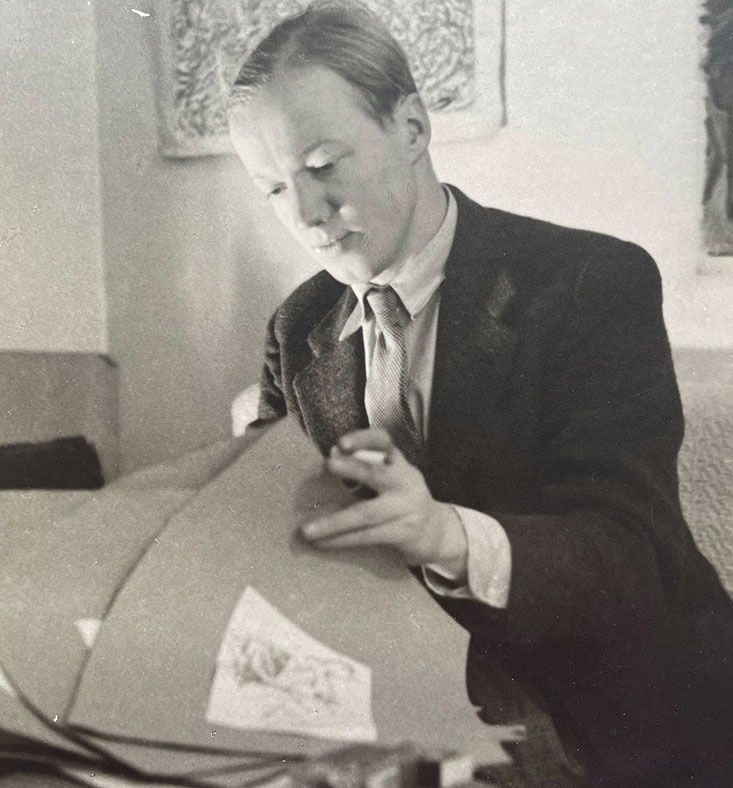
Folke, aged 26, at his parent’s house. One of his recent paintings hangs on the wall behind. Newly married, they were on their way to Sicily. April 1939.
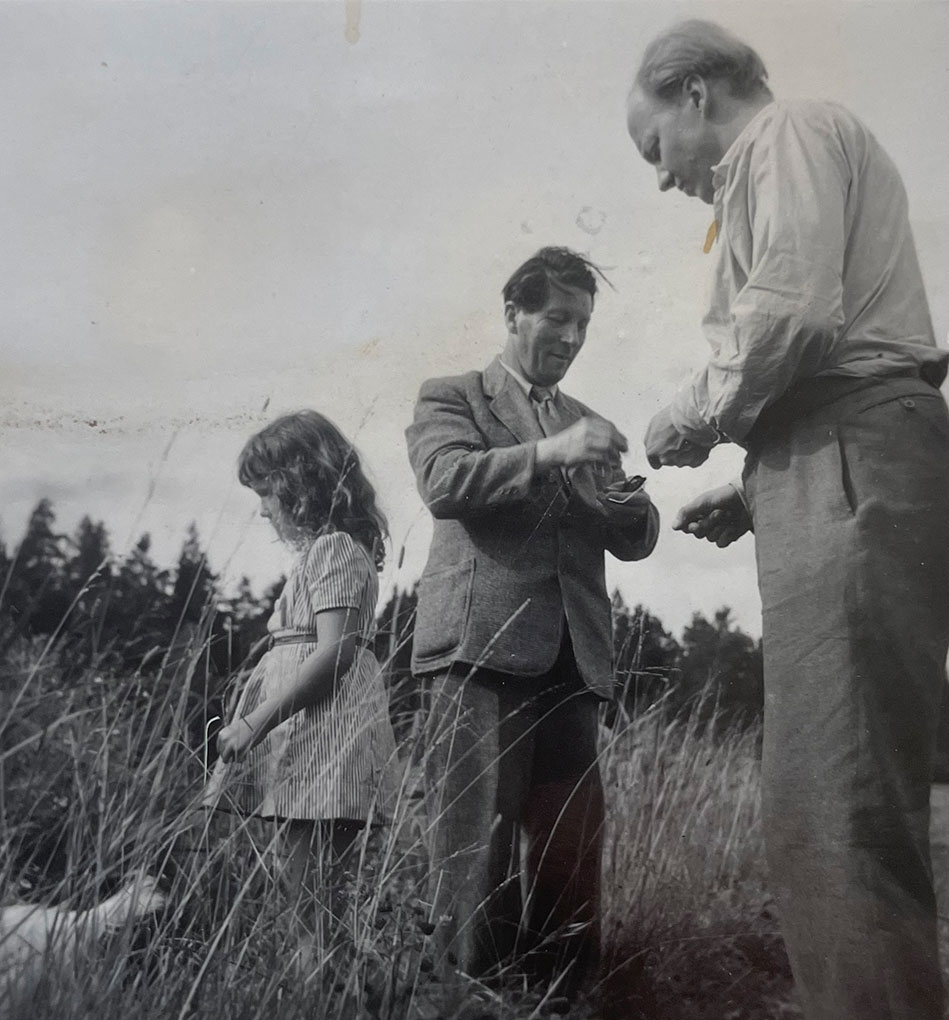
Folke with his daughter and Karl Sandberg, Director of Het Stedelijk, leading a party of young Dutch painters on a visit to Sweden. 1946.
Folke’s paintings started to blossom during a working stay on a farm in Colmschate, near Deventer, with another talented student, Jan Meine Jansen. Folke left his middle-class home and went to live in a working district of Amsterdam. In May 1938 he completed his course with great success.
Campendonck had inspired Folke with his own studies of the Lofoten Islands. Folke decided to paint in a comparable region in Sweden and chose the fishing village of Bönhamn. His father’s support enabled him to do this. Living in great simplicity among the fishermen, he produced many memorable paintings. This period culminated in a successful exhibition at the Van Lier Gallery, Amsterdam in March 1939.
Although only one work sold, there were favourable reviews in the national newspapers, including Algemeen Handelsblad – “The joyfulness of a young painter able to follow his chosen calling in surroundings entirely suited to his longings shines through in these works.” As van Lier recalled, “They (the public) wait for full fame and recognition with the attendant tenfold increase in prices, and then they buy.” The war scattered these paintings to the winds, with one or two exceptions, leaving only photographs as a record.
At just 26 years old, Folke’s vibrant, original and highly creative style was recognised in his first exhibition.
At Bönhamn, another painter was working. Brita Horn, eight years older than Folke, had trained at the Konstakademie in Stockholm, she was the author of “Folk och Färg”, (People and Colour) and the daughter of the Swedish novelist Viveka Horn. The young painters rapidly formed a relationship and married in January 1939 in Stockholm, with both families celebrating.
“It is not a question of whether something is good when you have put body and soul into it. The other factor is taste and quality”
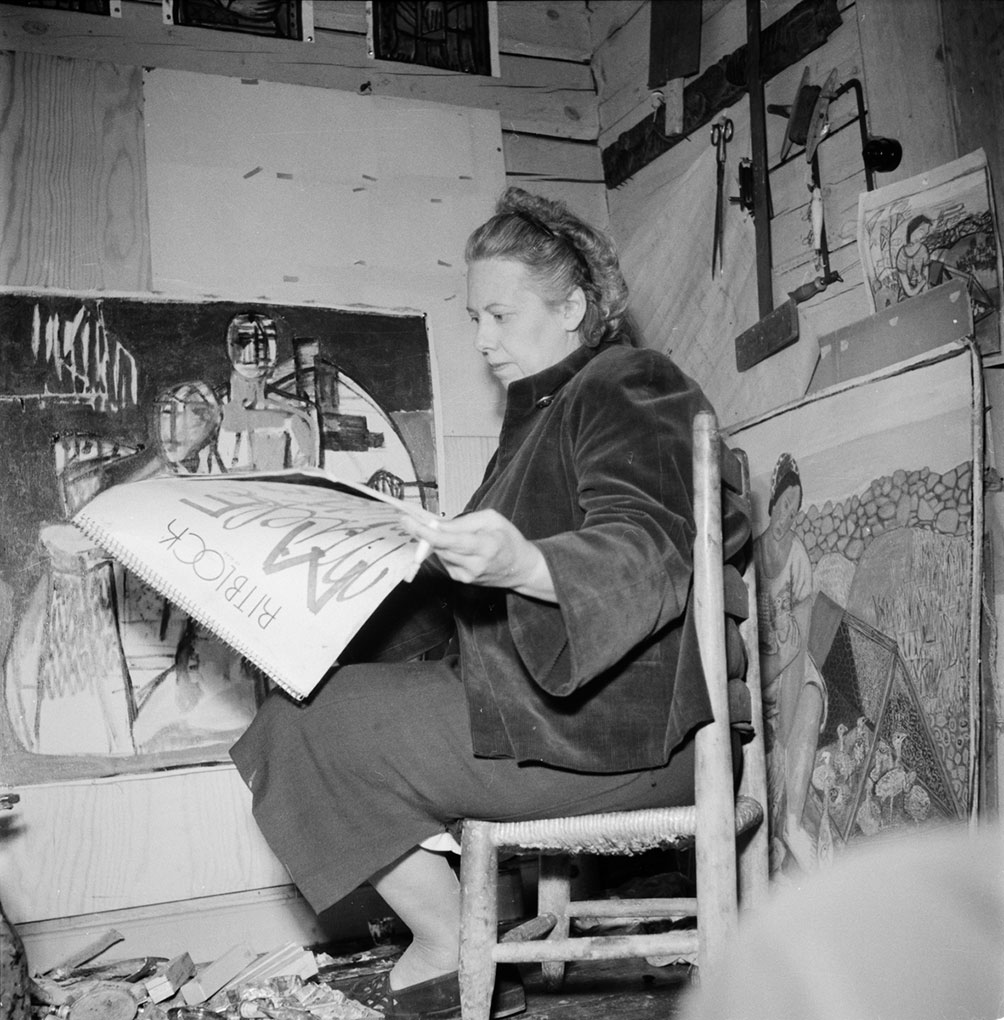
Brita, 1950. Paintings by Folke can be seen.
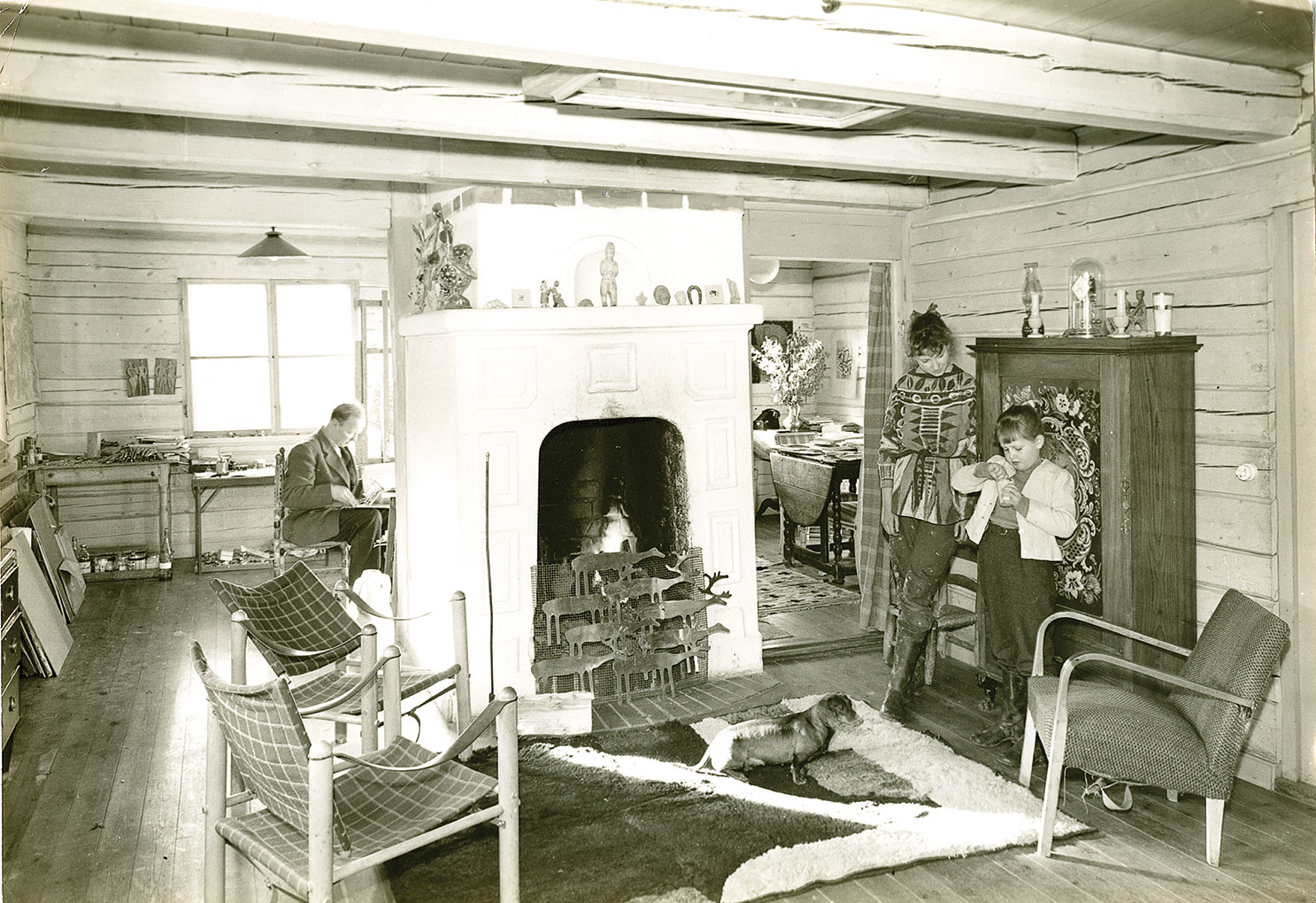
Folke with his daughters at Aspnäs, 1950.
After Folke’s van Lier exhibition, he and his new wife went to live and work in Sicily. Brita knew Italy well, she had been there several times as a companion to the Swedish painter Sigrid Hjertén, who was also married to a painter, Isaac Grünewald.
Folke and Brita settled in Monreale, overlooking the fertile Conca d’Oro, just a few miles inland from Palermo. Monreale has a magnificent Norman cathedral and priory, but otherwise, as reflected in Folke’s art, it was a place of extreme poverty.
After the outbreak of war in 1940, the Italian authorities threatened to intern Folke as a Dutch citizen. However, Brita, being Swedish, was able to employ her neutral status to secure passage for them both to return to Sweden.
Making the voyage in a Swedish merchant ship, they were anchored in the Orkney Islands naval base of Scapa Flow for 6 months between October 1939 and April 1940. Folke found this time extremely frustrating, with a complete lack of artist’s materials, and there are no known sketches or drawings from this time.
They finally arrived safely in Sweden just in time for the birth of Mieke Marion, their first child on the 21st June 1940, settling in the small town of Mariefred, 60 km outside Stockholm.
In 1941, Folke agreed with The Gummeson Gallery, in Stockholm’s old harbour, to represent him. The first of his two solo exhibitions was in January 1942, he sold the majority of his works, 30 oil paintings, 10 gouaches and 20 drawings. In addition to the exhibition’s financial success, Folke also achieved critical acclaim with reviews in 11 Swedish newspapers and three of Holland’s main publications.
During wartime, Sweden was isolated and it was difficult to obtain art materials. Folke’s art became almost abstract expressionist, very detailed, with paintings painstakingly completed.
The success of his Gummeson exhibition led to him being given a commission by the Lidköping Mekaniska Verkstad (LMK) for 5 large paintings on “The Spirit of Midsummer”. This was joyfully realised to demonstrate the lightening power of art in the works canteen there.
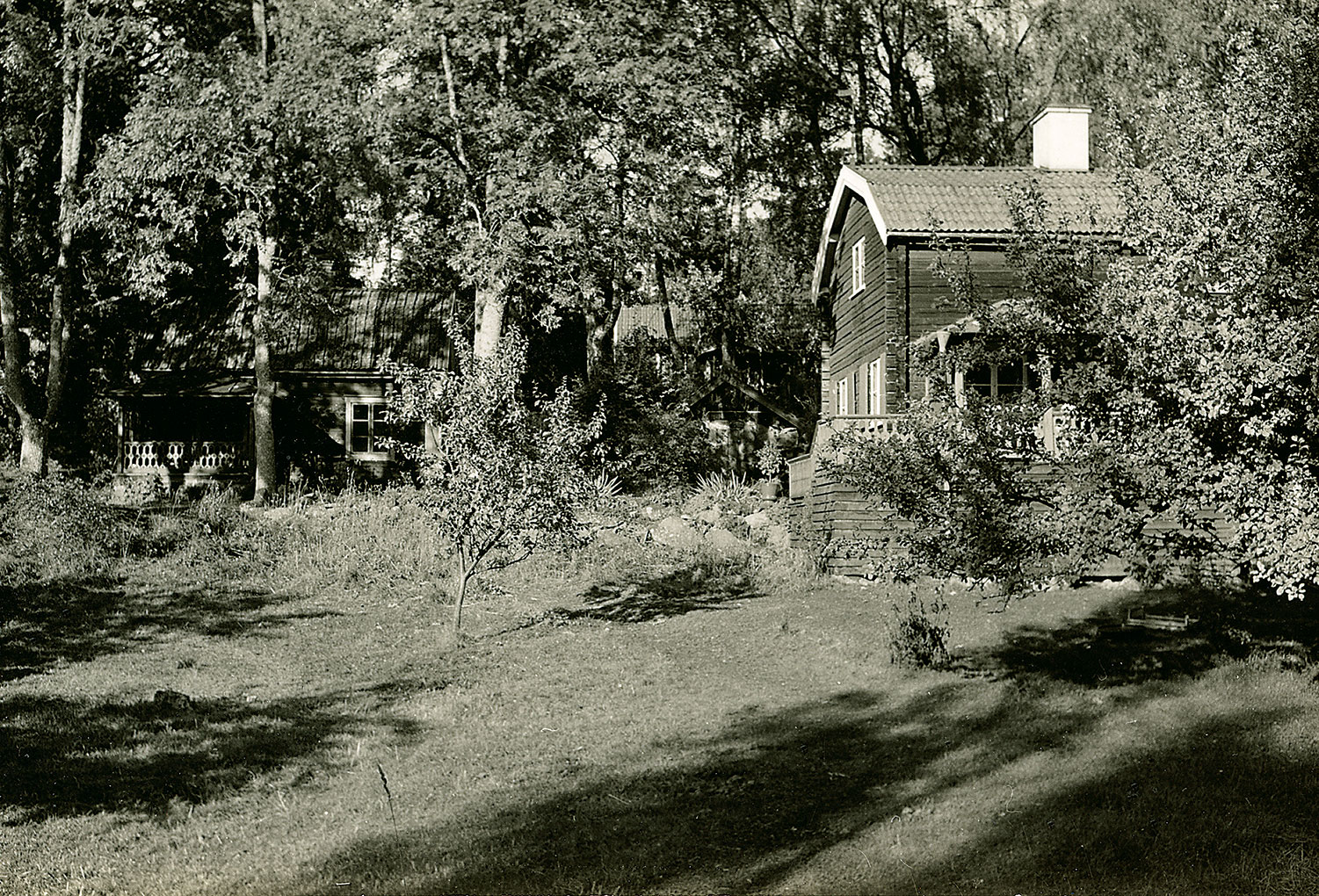
Aspnäs, Knivsta 1955. Designed by Lars Israel Wahlman in 1920.
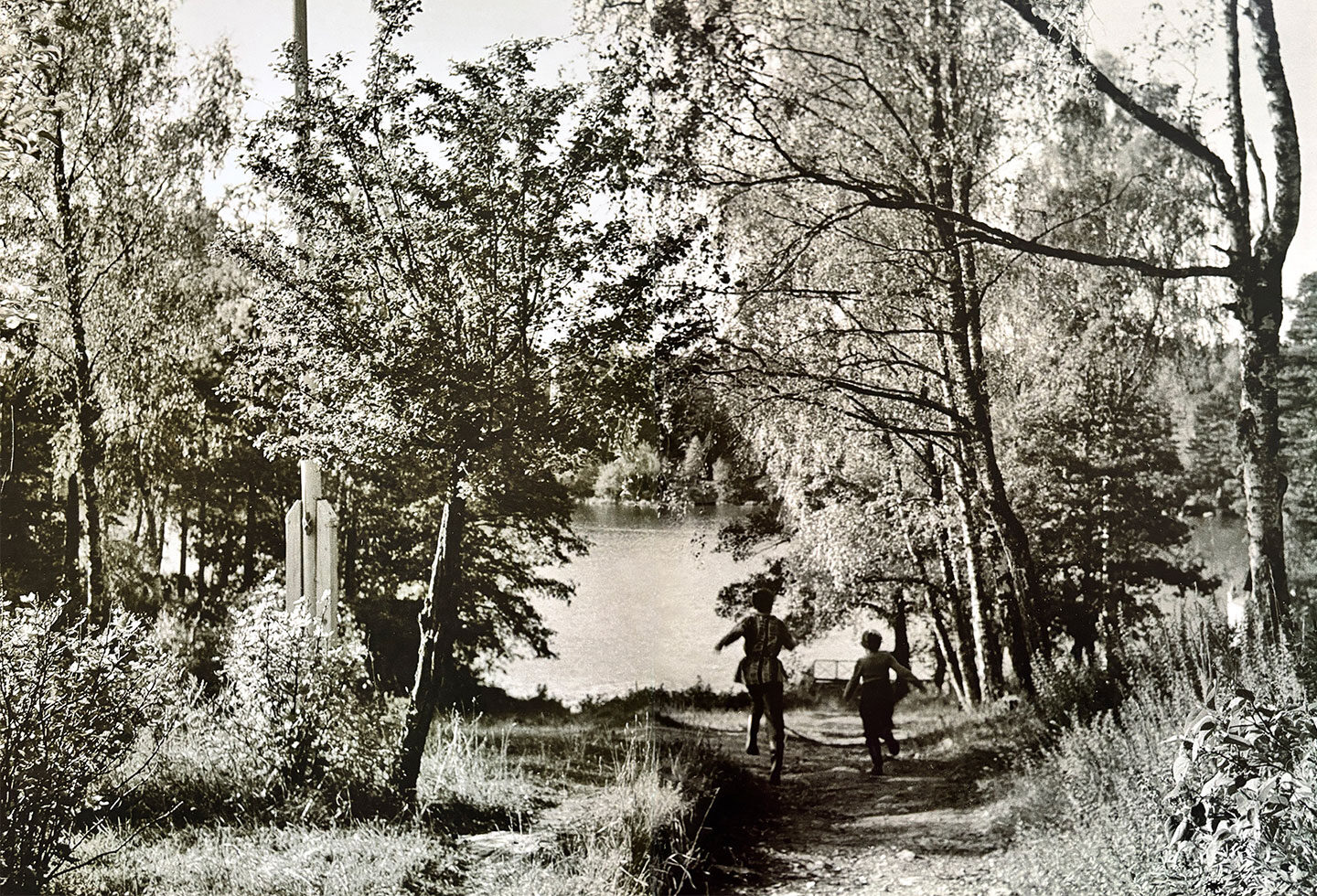
View down to the lake at Aspnäs, 1955.
Folke’s chief energies went into painting with no fewer than five solo exhibitions prior to 1951, including in Eskilstuna, Stockholm, Gothenburg and Malmö. He also made contributions to other collective exhibitions.
Hugo Gebers, the publishers, employed Folke to make 20 pen and ink studies of The Iliad, as book illustrations. The work was completed and paid for but never went to print.
In the early 1940s, Folke had met Alice Lund in Stockholm at the beginning of her weaving career. Having proved his skill at decorative design, she contracted Folke for two day’s work a month. This led to the very fruitful working relationship that lasted for over 20 years, Folke’s colourful abstract designs were made into rugs, drapes and pictorial weavings.
Two exceptional works of their collaboration were a depiction of Stockholm’s harbour for Kreditbanken headquarters on Store Plein and, for Stora Kopparberg’s Falun headquarters of a mining scene. Other works included theatre curtains for Kristinegården, a large altar weaving for Ånge Church, and several for the choir gallery and pulpit of Aspeboda Church. All these works were groundbreaking for their time.
These years were very successful for Folke, and he and Brita were blessed with a second daughter, Beatrice Kathrin, who was born in Mariefred on 23 September 1945.
By 1950 partnerships with other architects were also developing. Sweden had entered a period of great prosperity, with many new churches, schools, offices and court houses being constructed, each had an allocation for artistic embellishment.
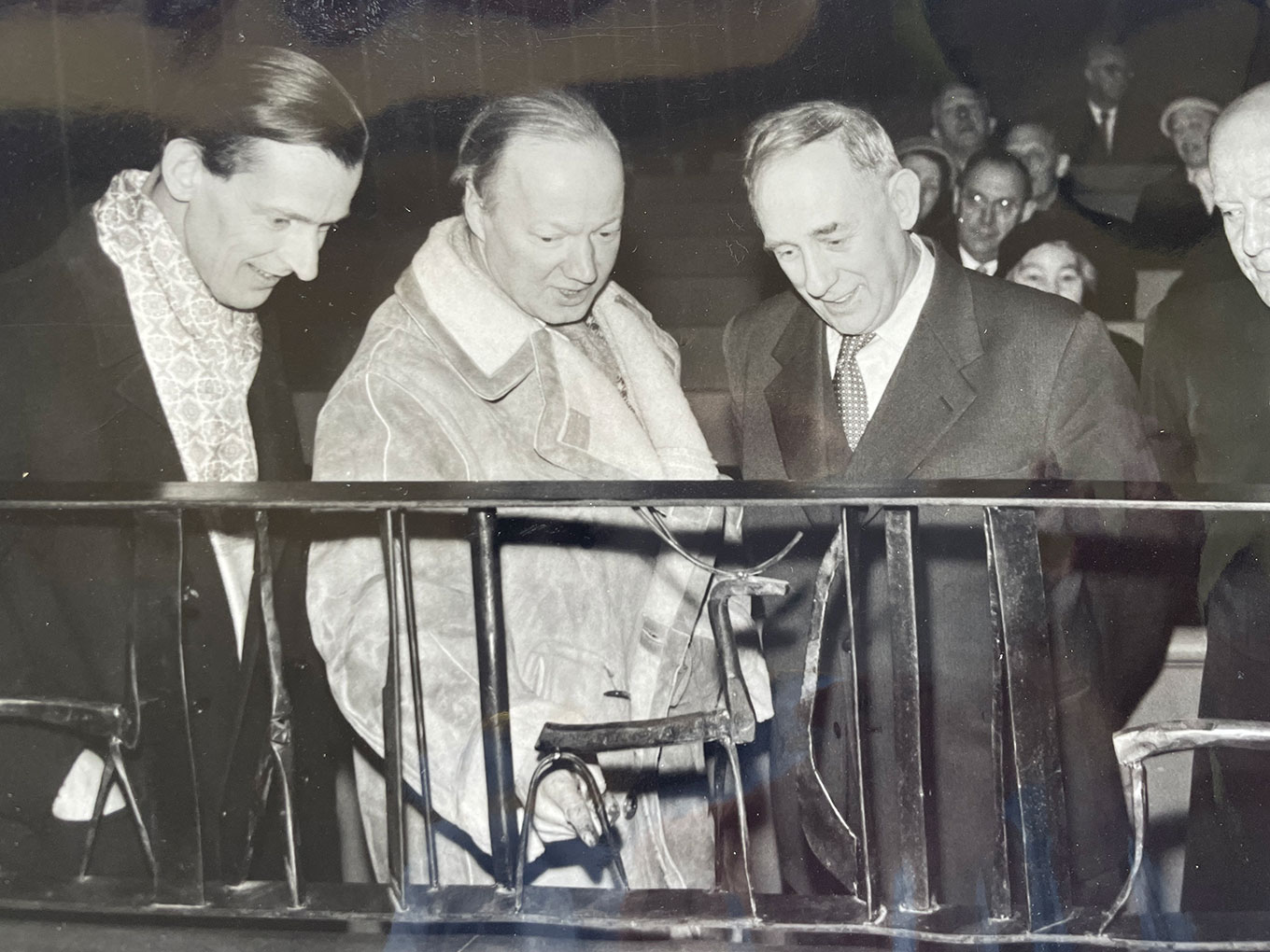
Folke at the opening ceremony for the altar rails in Näcka Church, with architect Sven Söderholm to his right. 1957, aged 44.
“I notice more and more as I age, instead of living through one’s surroundings and people, one finds freedom through work”
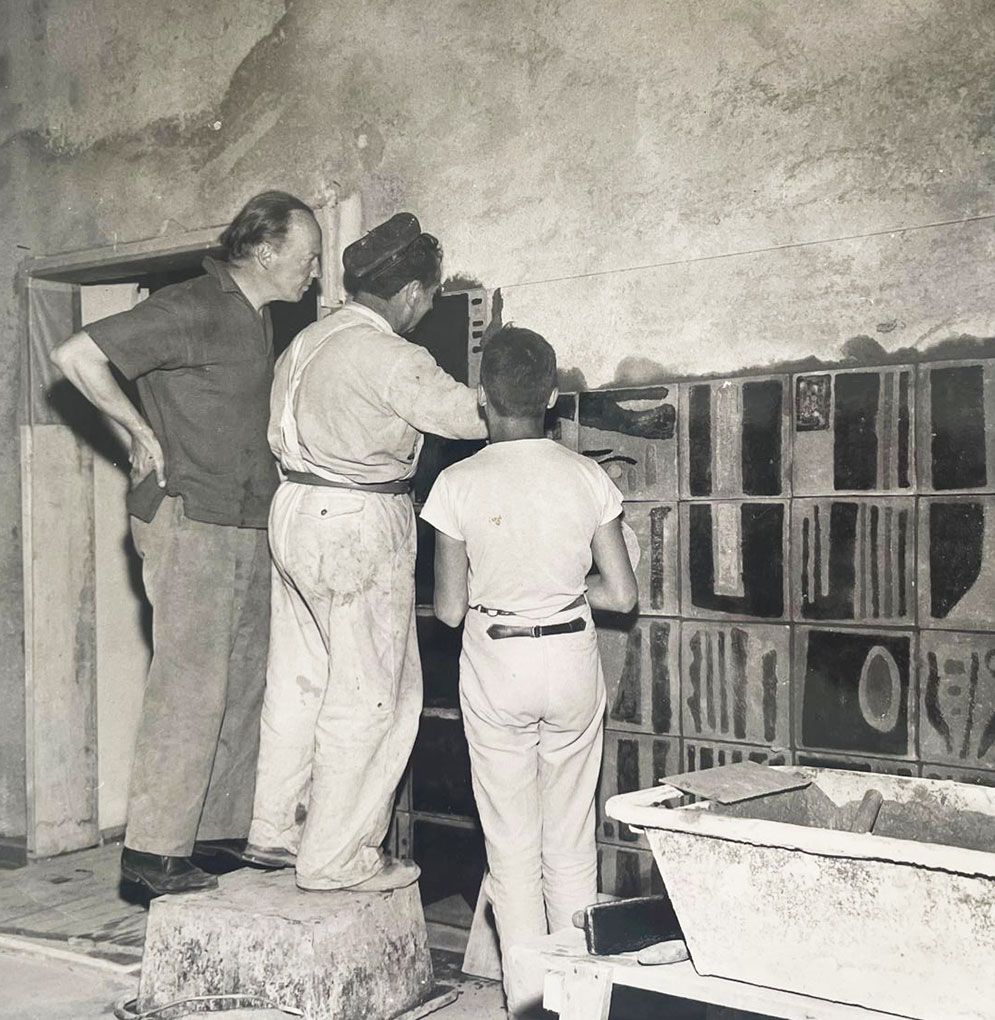
Folke, 1958.
Sven Söderholm commissioned Folke for stained-glass windows for new chapels at Säter and Sörsjö. At Skoghall Church, Folke designed with Erik Höglund of the Boda Glassworks the altar crucifix and the font. In their close collaboration, they developed new techniques working in glass and silver.
Folke was now almost constantly employed to make and design stained-glass windows. A particularly fruitful partnership with the architect Rolf Bergh reached its highest expression in the church at Östertälje, one of the finest built in post-war Europe. Folke added important decorative features to 30 churches in Sweden, these are detailed in Michael Heybrook’s biography of Folke “Art Titan” ISBN 978-0-955 3824-0.
Other outstanding examples of Folke’s stained-glass can be seen at the churches of Njurunda and Trävattna, the Crematorium of Uppsala at Berthåga, also the churches at Skövde, Vargön and Öglunda.
These remarkable achievements make Folke, after Chagall, the leading stained-glass artist designer of the 20th century.
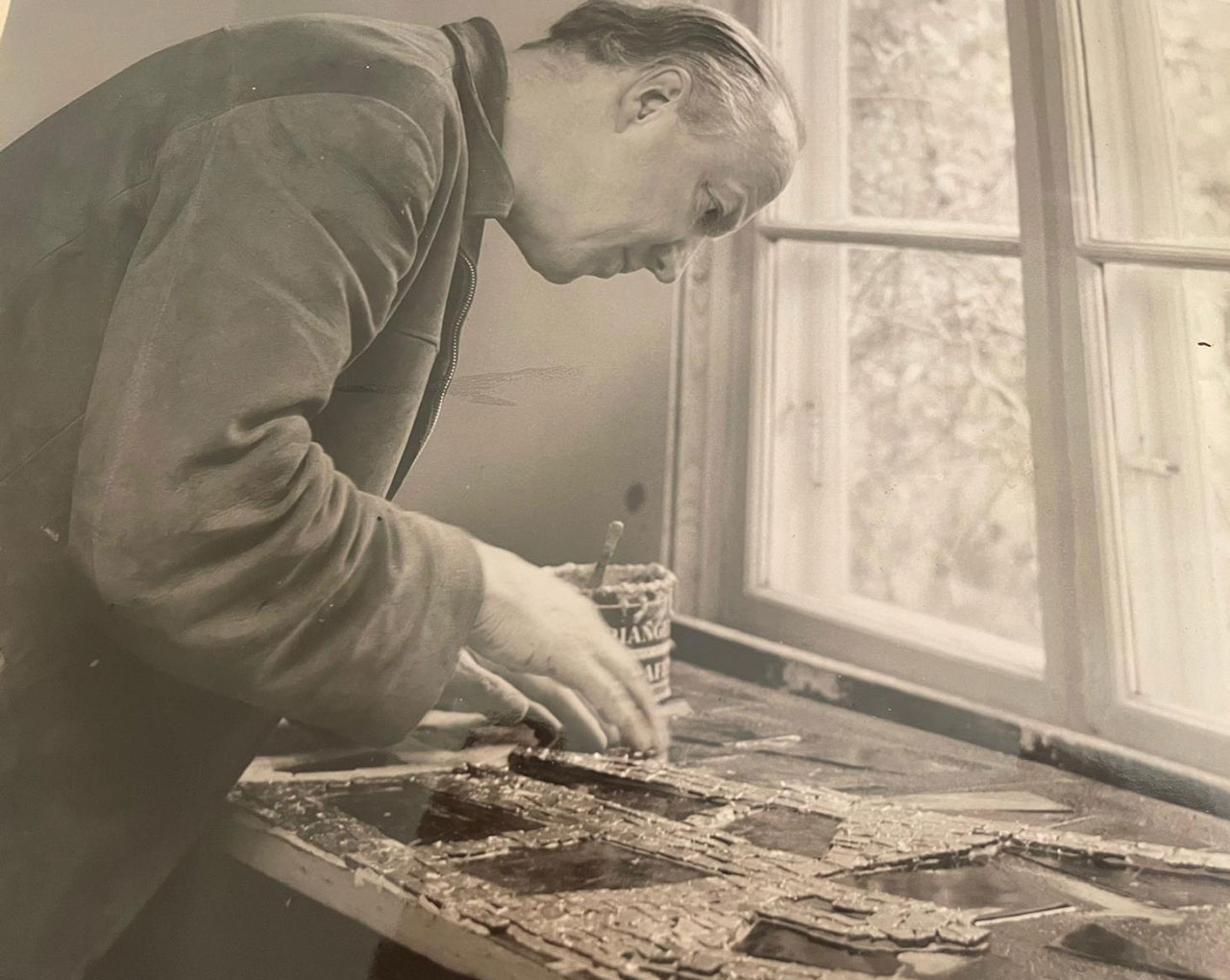
Folke working on the windows of Mariefred Church, 1958.
During the 1950s and 60s the pace of Folke’s work was unrelenting and hugely successful, with many extraordinarily varied commissions, both private and commercial, many of which can still be seen.
The dynamic of Folke’s work was further inspired by the purchase, in 1950, of Aspnäs, a beautiful country house beside Lake Valloxen, close to Stockholm and Uppsala, designed by Lars Israël Wahlman. The house had a lovely studio in woodland, with further studios for Brita and their two daughters.
Aspnäs became a vibrant meeting place for a numerous and international mix of artists, writers and musicians, critics and collectors. The house was hugely important to Folke as his home and place of inspiration.
However, after 1965 everything was to change. The spate of commissions ended, austerity had replaced the booming economy, and then news came that the new E4 Motorway would crash through their very house.
They were forced to leave. The spell was broken. The magical setting of Aspnäs could not be remade elsewhere. The romantic undertaking of moving to beautiful Nykvarn’s Mill, near Enköping, proved unsustainable, within three years its expensive maintenance was too much, coupled with the current lack of work that Folke was suffering from.
By 1968, near bankruptcy, and with the decision to live with an old love, Nell van Norden-Blauboer, Folke moved to Naarden, in Holland. At last this meant a return to painting, there had been so little time for this at Nykvarn where he had been constantly repairing the buildings.
Settled in Naarden a flow of Dutch genre painting was unleashed, inspired by contemporary living. In May 1973, Folke held an exhibition of 40 paintings at Galerie Sfinx, Amsterdam. Wonderfully, nearly all sold.
In 1974 however, disaster struck again, with Folke losing his daughter Beatrice. The great sadness stopped all thought of painting and work for over two years. Out of economic necessity however, he accepted Rolf Bergh’s request for stained glass windows at Byttorp and Rydd Churches. Gradually, with this work and the help of friends, Folke began to recover and completed many other individual painting commissions, a series “Holland on the Water” “Mongrel Dogs” and another group of beachscapes date from this time.
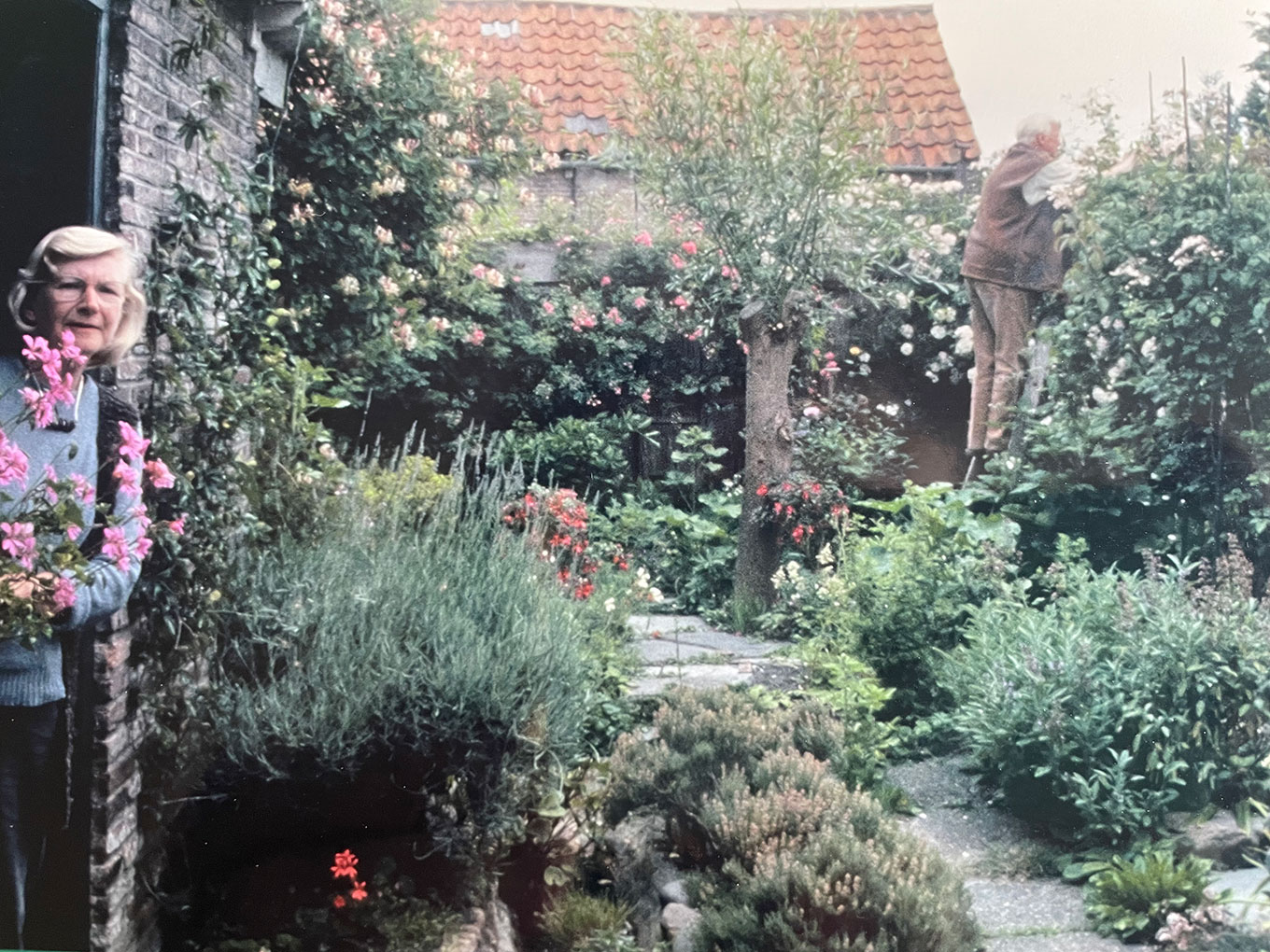
Folke and Nell, Zierikzee, 1981.
Increasingly dogged by ill-health, he managed fine windows for Vargön and a concluding masterwork of three altar windows for Öglunda Church, before succumbing to prostate cancer aged 69 years on 28 February 1983 in Zierikzee, Holland.
Folke’s life had been filled with the warmth of family and a stream of friends and fellow artists. His commissions placed him firmly as “the artist craftsman in society”, providing so much joy and insight with his skill and such original imagination. He brought humour and vitality to his art and any conversation and company. He was welcoming and approachable, generous with his time and always interested and enjoying new challenges.
A wonderful man.
“Journey to broaden one’s mind and bring pleasure to others”